Showing posts with label homemaking. Show all posts

Wednesday, September 17, 2014

Homemakers: The Homebuilders of the World


Homemaking skills are so needed in this world.  Today, these important skills should not only be taught to daughters, but also to sons.  Here is the homemaking formula I found in an old church manual:
imagination + skill = creativity
creativity + production = satisfaction
homemaking x creativity = happy living
happy living divided among others = love

I like the idea of training oneself to be a homebuilder.  A certain amount of professionalism should be applied to building our homes.  You get so much more accomplished if the job is taken seriously.  As a homemaker for more than twenty years, I thought of myself as the manager of my own home.  As with all managers, the job requires organizational skills.

To be a successful homemaker it helps to study as much as possible the best ways to go about housework, food preparation, organization, decorating, taking care of plants, pets and raising children.  One homemaker gave the following description, "I learned organization as the mother of a four-year-old and newborn twins. I never got over it.  I still read things, and I write down little bits of information, for later use" (Mary Ellen Jordon Haight).

There are so many great blogs now that are much easier to read than volumes of books. God bless those people who break everything down picture by picture. There's a special place in Heaven reserved for these sharing teachers who do not assume we are all brilliant.  This is just one of the wonderful homemaking blogs available to us now:

homegrown mom
http://homegrownmom.com/homemaking-for-girls-30-days

Wednesday, August 13, 2014

Grateful Living: Reflections on HOME


This is my post to share a touching story and lovely quotes about the most important place in a person's life--their home...

Best Snowflakes on the Block
It is Christmastime on our street. The homes are decorated with tinsel and many-colored lights. Some windows frame beautifully decorated trees, and well-shaped wreaths hang on the doors. At one home, however, a little confusion of homemade snowflakes congregates in the picture window. They are hung in childhood fashion (not in the adult perfection of other windows nearby) and whisper a special secret about the occupants of that home.

I want to share a secret with you. The secret is that children are more important than picture windows; that fingerprints and boot-drips and carpet stains aren't nearly as important as a child's self-esteem. Those little white snowflakes tell me something more. They tell me that smashed bouquets of dandelions adorn that kitchen table in the springtime and are loved as if they were the most beautiful of imported orchids. They tell me that a pet potato bug in a box can live there unmolested, that helping with a bug collection is just as important as doing the wash, that viewing the first violets of spring with a child's hand in yours is better than a shiny floor, that listening to a child's fears is more important than television, that children's art is more beautiful than the greatest of the old masters.
Oh, they do tell a special story, those snowflakes.
(Sherlene Parker, Ensign Dec. 1976)

A small house well-filled is better than an empty palace. ~Thomas Haliburton

Houses that express comfort and well-being can go a long way toward making us feel at home in the world. ~JoAnn Barwick

Everything in the White House must have a reason for being there.  ~Jacqueline Kennedy

Tis a gift to be simple, tis a gift to be free...Amish song

'Mid pleasures and palaces, though we may roam,
Be it ever so humble, there's no place like home.
~Pa, Little House in the Big Woods

God bless this house And all that's in it
A garden of flowers Some books for the hours
Sweet dreams Good Health
and Love, glorious love. ~unknown

“...I remember thinking how often we look, but never see...we listen, but never hear...we exist, but never feel. We take our relationships for granted. A house is only a place. It has no life of its own. It needs human voices, activity and laughter to come alive.” 
― Erma BombeckA Marriage Made in Heaven: Or Too Tired for an Affair


Thursday, October 31, 2013

Decorating with Vintage Linens

The bathroom needed a quick curtain when I finally retired some defective plantation blinds.  I loved the idea of using vintage doilies, cut work, etc. to decorate simple curtains and took a piece out of my stash for this quick fix.  


I really like cafe curtains.  They provide ample privacy, plus they’re easy to open and let in plenty of light and air when desired.  I was inspired from a photo where doilies had been randomly sewn onto similar curtains.  My bathroom also has an open space in the sink cabinet where the laundry basket is kept behind two matching vintage pillowcases.  


The lace at the bottom was handmade.  None of my collected pieces of vintage linens are in perfect condition though I have made an effort to keep them carefully laundered.  I feel that the faint stains, worn areas, and other imperfections give the pieces charm—a story.  It is hard to believe there was a time when women would have the knowledge, time, and inclination to make beautiful, comforting, and useful decorations for their home.  I am glad to find any way I can to incorporate such history into my own home.


I am looking for more ways to use my stash of hand-made finery.  Share your ideas of how to use vintage pieces like the ones I have shown.


Friday, June 14, 2013

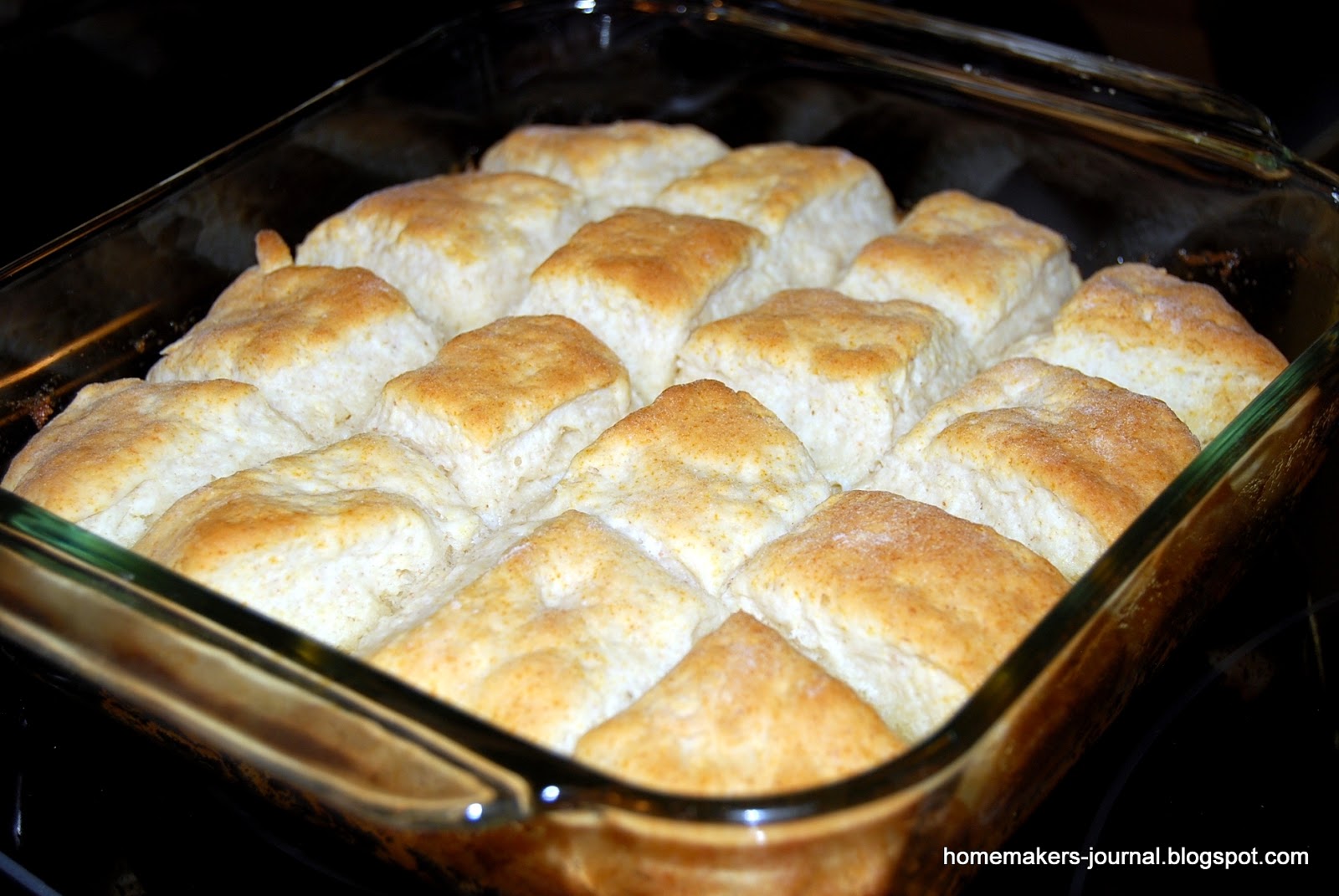
Perfect, Easy Biscuits

There are a few things that I think every homemaker should be able to do well, and one of those is make perfect biscuits.  I found a fabulous recipe for 7up Biscuits using Bisquick from www.plainchicken.com.  I was so excited to find this different and easy recipe using Bisquick since I make my own homemade version of a quick mix which uses wheat.


The recipe can be found and printed out at www.plainchicken.com.  I will describe the process adding some helpful hints for those who may be biscuit-making novices.

Step-by-Step Procedure

Heat the oven to 450 degrees F.

I go ahead and melt one-fourth cup of butter in my 9 x 9 inch pan in the oven.  Be sure to take the pan out when butter has melted so it won't brown.

Place two cups of Bisquick, or your own quick mix, into a large mixing bowl.  You can make a well in the center if you like and place a half-cup of sour cream (I like Daisy).

I actually work the sour cream gently into the Bisquick with my fingers until the sour cream has wetted most of the flour mixture thoroughly.

Then I pour 7 Up into a half measuring cup but more-than-likely, I will not use the entire half-cup.

Just sprinkle the 7 Up by Tablespoon over the top of the sour cream and Bisquick mixture.  Use a fork to fluff the 7 Up throughout the mix.

When most of the Bisquick has formed a ball in the center with just a little bit still hanging to the sides of the bowl, the dough is probably ready to gently knead together on a lightly floured counter.  The key is to use as little flour when kneading and only knead enough to be able to pat dough into a square.

Since I don't want to overwork my dough, I don't bother with the biscuit cutter.  I just pat the dough into a square slightly smaller than the measurements of my 9 x 9 inch pan (or 8 x 8), rather than use a rolling pin.

Use a sharp knife to cut into squares.  Then I place each square right onto the butter in the pan basically in the same exact way that I patted and cut it out on the counter.

Bake for 12-15 minutes, or until golden on top.  Cool in pan on a cooling rack (if they last that long!)  They are best served hot from the oven.

Baking Mix Recipes to Try

I like having the biscuits slightly connected so they are flaky and  moist.  This recipe is so good, the texture is almost like making yeast rolls.  This would be a great recipe for camp and cooked in a box oven!  My box oven instructions can be found at Homemaker's Journal, Easy Outdoor Cooking Recipes post.

For more delicious Quick Mix recipes see Homemaker's Journals beautiful and delicious Christmas Coffee Cake post and scrumptious Quick Mix Pancakes found at Some Favorite Campy Things, part 2.

I hope you enjoy this recipe as much as our family has.  I like to experiment with recipes using soda pop as an ingredient.  How do you use soda in your favorite recipes?

Monday, April 1, 2013

Laundry Rules!

I have a family of five:  a husband, a junior boy in high school, a sophomore girl in college, and a senior girl in college.  The two college students have had to come home and finish up at local colleges because our family’s single income has continuously gone down since Obama was elected (both times).  I’m back in school recertifying to hopefully attain that non-existent teaching position.  Therefore, it has been my mission to not waste a dime if I can help it. 

Photo from Homemaking for Teen-agers, Book 2, McDermott and Nicholas, 1958, p. 190


Where is Income Being Wasted?

Some major household expenses are utilities, food, and clothing.  These are things everyone basically wastes money on even though we generally have nothing to show for it when all is said and done.  Once we eat food, it’s gone (only the memory of a tasty meal and maybe an extra pound or two remain).  And when we take that extra-long shower (more than 10 minutes), or leave all the lights on and run the TV no one is watching, etc. nothing remains of this expense as well.  Some of us are very good at purchasing and caring for “classic” pieces and shoes that are well worth the initial expense.  However, more than likely, we buy clothes that will be outdated and worn out from misuse well before the expense has been worth it. 

Another Dave Ramsey Reference

I recently heard Dave Ramsey tell a man with a single income of $140,000 (I wish) that if his wife would invest $600 a month on a mutual fund for the next thirty years (she was forty), by the time she was seventy the mutual fund would be worth OVER TWO MILLION dollars!  Her issue was having the latest fancy car, but how much do we spend on clothes each month?  How much does that accumulate each year?  How much would we have if we were more careful with our expenditures and invested the money saved on electricity, food and clothes into a kick-!#* mutual fund.  I would like to be a millionaire if I’m lucky enough to reach seventy!  (P.S.—Dave didn’t mind if she had a fancy new car—just pay cash for it!  And with their income, and only buying a new car every three or four years, why would you not be able to do that?)

Take Care of Investments

Any-hoo, the point of this post is that I find myself at this late date, having to teach The Fam how to wash clothes so they don’t ruin my irreplaceable Whirpool Duet washer and dryer purchased in much happier financial times.  Since I hope to find regular work soon and cannot be on top of the clothes-washing situation, I have to protect our investments of appliances, clothing and utilities.  Plus, it would be nice if everyone knew how to wash clothes properly.  Hence—The Rules. 


The Rules

Believe me, there’s a story behind each rule.  Hopefully these rules posted above the washer and dryer will promote appreciation for how much things cost because “the buck stops here.”  No more Mom buying fancy detergents, clothing for school or gifts, or water and electricity to re-wash forgotten clothes that have mildewed in the washer overnight.  I encourage folks to start their own rules earlier than I did—kids (and husbands) can learn to wash clothes as soon as they have enough to make three loads of just their clothes!  Does this mean they will do it right when they leave home?  Apparently not.  But it won’t be because we didn’t try!  These are the rules for our home:

If you have a problem with these rules, the machine owner (Mom) will be glad for you to take your laundry elsewhere:

1.   Do not start laundry after 9pmFold and put away each load immediately!!!
2.   Never use the Heavy Duty or Whites Cycle without the owner’s permission.  If the clothes are extra dirty or the load a little larger, press the button for more or less soil.  There is even a soak function if the clothes need to soak a while.  Whites and Heavy Duty take much more electricity and most of the time the normal cycle will suffice.
3.   ________ can wash her clothes with Mom’s since she has "so few clothes" because you can never wash all your clothes in one load—that will cost money in the long run due to clothes deteriorating quickly with such abuse.
4.   Everyone has a clothes basket assigned to them.  Only two people—________ and ________—may keep their clothes baskets in the hall bathroom.  DO NOT put your clothes in those baskets unless they are yours!!!!
5.   Everyone should do at least 3 loads of clothes each time they do their wash—DARKS, WHITES, and COLORS.  You can put it on a smaller cycle or get with someone else to make a larger load.
6.   Only ________ washes his clothes with the hypoallergenic detergent.  ________ has bought Gain, and Mom buys Wisk or New Era (red bottles) and Cling Free softeners.  There will always be a $1 detergent and softener available to those too cheap to buy their own.  Most of the time you fill the dispenser only 1/2-full of detergent.
7.   Only wash clothes if you will be available to take them out immediately and start the next load immediately.  With everyone doing their own wash, it will take forever if some refuse to stay on top of their laundry cycles.

Laundry Rules! Printable

In this economy, Dave Ramsey is a hot commodity.  Do you agree that you should "live like no one else so that someday you can live like no one else?"

Monday, March 4, 2013

How to Teach Children Responsible Behavior

I have been really surprised by how irresponsible our society has become—especially in the highschool and college venue.  Twenty-five years ago, my professors didn’t take excuses, you just got a zero.  Now high schoolers and college students can talk their way into extensions and prompting the answer to test questions from the instructor and other forms of CHEATING.  From what I hear, cheating is a real problem in high schools and colleges everywhere.  Apparently it’s a problem in the work force as well.  I think cheating is a form of being irresponsible.


Responsibility and other character issues will be taught by me to my own children now, and the children in my care when I am a teacher.  In the 1990’s, Character Education became important to many Americans.  There was even a movement—I remember getting these great little books and tapes on different character traits every time we went to Chick-Fil-A for kid’s meals.  (I believe there was an immoral president in office at the time?) 

Responsibility is a character trait that I feel needs more emphasis in schools since fewer children attend church regularly and have a very good chance of not being taught responsibility at home.  In a recent education class to recertify, I learned something new about teaching children responsible behavior. 

It was so exciting I immediately made a chart to use in my future class.  Hellison (2011) is cited in the textbook, Dynamic Physical Education for Elementary School Children (Robert P. Pangrazi and Aaron Beighle 2013).  On pages 108-110, the text gives a very good breakdown of his hierarchy of responsible behavior we can teach children.  I found this very enlightening for myself even! 

I’m sharing the chart I created with my D.J. Inker’s Dazzle Daze (2000) graphics I bought (I love her artwork!)  I had a little Family Home Evening lesson with the family and gave each of them a handout with the hierarchy of responsible behavior.  Then I also permanently displayed the chart on the front door.  We discussed what each level beginning with 0 would look like in real life and gave real examples.  Then we judged where we might be on this scale.  It’s a very real possibility that in different aspects of our lives we could be in more than one place.  The goal is to accomplish all levels leading up to the highest as the most desirable responsibility traits to attain.  Of course there might be setbacks to overcome.  I tried to put the chart in terms that even First Graders could relate to and understand.

Hierarchy of Responsible Behavior Printable

How do you help your children learn responsibility and do you think people are becoming less responsible in today's world than they were even a decade or two ago?

Monday, January 21, 2013

Love Affair with Pantries


I've had a love affair with pantries since I was a little girl. My next door neighbor had this whole closet right off the kitchen where she kept all her food.  This looks very much like the pantry she had in her early 1950's home. It's the type I want the most if I had a choice.  How convenient to just enter a room and be able to see everything you have at a glance!  I think all kitchens should have this included in the house plans.

My Grandma's kitchen had several mysterious rooms.  There was a mud room with a deep sink and updated with a washer and dryer. A screened-in porch where I'm sure many a pea was shelled and maybe used as a sleeping porch (the room was later closed in as an extra guest room).  Grandma had a lovely butler's pantry that she kept a giant, ancient freezer chest.  The room had windows in the alcove area and a built-in china cabinet.  But the most mysterious and unusual room was a long narrow closet that was her pantry.  From top to bottom the closet was lined with sturdy shelves.  It reminded me of the one the chauffer took a can of salmon out of in "Driving Miss Daisy." 

In The First Four Years, by Laura Ingall Wilder, Almonzo built the most amazing pantry in their new home.  The description includes flour bins!  I love to study the illustration shown in the book. 

Before Pinterest, I kept magazine clippings such as these, organized in a notebook, as inspiration for my ultimate pantry (I apologize for the picture's graininess.)  I've seen the first couple of pictures pinned on Pinterest that I clipped from a Martha Stewart Magazine years ago. 

From Martha Stewart Magazine
This is a great organizational idea for keeping up with and rotating food storage and supplies.  Another great idea comes from Ensign magazine for using an easy pocket chart system where even children (and husbands) can help.
From Martha Stewart Magazine
This is a great idea for those of us who must keep our storage in the garage or basement.


Here is an excellent way to use space inside the walls.  I love it cause you can see what you have, and yet it's still kinda hidden and there's the old-fashioned feel of a screen door.  Of course I don't find screen doors like this practical anymore on my front and back doors and opt for more energy-efficient storm doors, so getting to use a screen door somewhere in the house is nostalgic and you can often find them discarded and needing just a little TLC.


This pantry is what most new homes provide and is the simplest and least expensive for those of us who have an extra traditional closet to use.  I've seen a lot of good ideas on Pinterest for organizing pantry items using this storage system.

from Southern Living Magazine
I include this picture just because it is so inspiring.  Maybe one day I'll get my act together and have such an array of home-canned items.  Right now I'm lucky if I get jam or jelly done each year.

Monday, December 31, 2012

The Hand That Rocks The Cradle

picture from KnickofTime.net
William Ross Wallace (1819-1881)
BLESSINGS on the hand of women!

Angels guard its strength and grace.
In the palace, cottage, hovel,
Oh, no matter where the place;
Would that never storms assailed it,
Rainbows ever gently curled,
For the hand that rocks the cradle
Is the hand that rules the world.

Infancy's the tender fountain,
Power may with beauty flow,
Mothers first to guide the streamlets,
From them souls unresting grow—
Grow on for the good or evil,
Sunshine streamed or evil hurled,
For the hand that rocks the cradle
Is the hand that rules the world.

Woman, how divine your mission,
Here upon our natal sod;
Keep—oh, keep the young heart open
Always to the breath of God!
All true trophies of the ages
Are from mother-love impearled,
For the hand that rocks the cradle
Is the hand that rules the world.

Blessings on the hand of women!
Fathers, sons, and daughters cry,
And the sacred song is mingled
With the worship in the sky—
Mingles where no tempest darkens,
Rainbows evermore are hurled;
For the hand that rocks the cradle
Is the hand that rules the world.

Northrop, H.D. Beautiful Gems of Thought and Sentiment. Boston, MA: The Colins-Patten Co., 1890.

Found at Poem of The Week: 


Monday, December 10, 2012

When There's Nothing Else to Eat

So I was making a grocery list to determine what I had in the fridge and what I needed from the store.  I noticed that there was about a cup's worth of leftover turkey (or chicken, or ham), a long stalk of celery, a couple of sliced green onions, a couple of handfuls of shredded sharp cheddar cheese, and mayonnaise in the refrigerator.  Then I checked the pantry and found half-a-box of small elbow macaroni.  I never do this--I'm not creative with food, I normally must have a recipe--but for some reason these ingredients just came together in my mind as a really good salad.

I put off going to the store and cooked the macaroni, chopped the meat and diced the celery.  After rinsing the macaroni in a colander under cold water and quick-drying it on paper towels on the counter, I combined all the ingredients together with enough mayonnaise to moisten.  I didn't season it with salt and pepper, leaving that for family members to do.  Then I tried it.  Maybe I was hungry but it was the best macaroni salad I've ever had!

I'm writing this post just to remind myself how I made it.  Even though it's simple, I'm liable to forget.  This was enough for 4-6 large helpings.  (My daughter, a 115 lb. college cheerleader with a coach who will tell you you're fat, actually went back for a second large helping.  This is not normal for her!)  It just goes to show you how often we throw food out or think we have nothing to eat when the leftover and last bits of something can turn into a fabulous (if simple) dinner.  All the ingredients are "to taste."  Some might like more of one thing and less of another.  Print Recipe

Turkey Macaroni Salad
1 cup small elbow macaroni, prepared (or whatever pasta you have on hand)
1-2 cups turkey, (or chicken, or ham), cooked and chopped
1 stalk of celery, diced 
1-2 sliced green onions
1/2 cup grated sharp cheddar cheese 
1/2 cup mayonnaise (enough to moisten the ingredients)
Prepare macaroni according to directions.  Rinse in cool water and drain thoroughly.  Combine all the ingredients adding more mayo if necessary.

Tuesday, November 27, 2012

Time Out for Homemakers

Delegate

A love of homemaking does not always come naturally.  Taking simple steps can keep homemakers from feeling their work is drudgery.  First of all, homemaking requires a few reality checks.  Real life means that keeping house may not always turn out as perfectly as we would like.  Even the best homemakers simply do not have the time to do all that they would like or as well as they would hope for.  When all the children were at home and outside activities and obligations were at an all-time high, I had to learn to delegate as many tasks as possible to the children and my husband. 

My husband’s career was very demanding at the time all the children were in school and with a lot of outside interests, so I asked him to do only a few things that could be done with a child “helper.”  We parents might wish to complete tasks more efficiently than we could with a small child or reluctant teenager, but household tasks can become great bonding experiences where teaching and sharing occurs naturally when we involve our children.  Though tasks done with the family member's help or delegated to family members may not turn out as well as if done yourself, they do get done and time is freed up for the homemaker’s higher priority items.  Through consistent practice, helpers will improve with their assigned tasks.

Reevaluate

Assigning tasks to others is a good time to really evaluate whether all tasks are actually necessary, anyway.  Reevaluating daily activities of all kinds and whether they are wasteful could free up time and energy for the homemaker.  For example, time can be wasted just looking at the mail.  Most of the time junk mail gets shredded immediately and catalogs thrown out in our house.  Measures have been taken to prevent most junk mail from ending up in the mailbox in the first place. Answering only essential phone calls is also a real time-saver (you do not have to take a call on your cell phone in the Walmart bathroom stall BTW). 


Recuperate

I have blocked out Mondays as “My Day” to recuperate from the weekend and plan my week.  I relax my standards and just ignore the dirty floors and dishes and cook a simple meal for dinner.  Many times dinner is a meal that was doubled and frozen for later.  If I do any cleaning it’s my own clothes, personal bathroom, and bedroom that get done.  It does not have to be Monday—but at least one day a week is “MY DAY” and I look forward to it!

Become A Homebody

Before running errands, plan them out on paper first to use gas and time efficiently.  I usually reserve Fridays as the errand day and I try not to make any extra trips until then.  Errands can really zap your time, money, and energy but some people like the excuse of “getting out.”  If staying home seems stifling, make your home more inviting for you to be in.  After consulting magazines and the internet, I learned to create a spa retreat getaway in my master bedroom/bath.  It is a place I love to be.  Creating a love for home can be done by creating a special space in the home, garden or yard; taking long walks in the neighborhood and enjoying the beauty of nature; having regular visits with a neighbor who also likes to visit; spending time playing with pets or children; practicing yoga during your children’s “quiet time” or nap time; develop a hobby or learn something new.


Luxuriate

Being a homemaker might mean living on a very limited income, but we can still pamper ourselves.  One thing I love is dark chocolate covered dried pomegranate fruit found at my local grocery store.  It tastes like it came from a gourmet shop.  I hide a bag of these in a drawer for when I need a special treat just for me.  I also like to try DIY spa treatments like the ones found in Take Time Out:

·         Steam Clean.  Fill a large ceramic or glass bowl with boiling water and drop in one herbal tea bag for each cup of water.  (Try chamomile, lavender, peppermint, or lemon tea bags).  Cover your head with a towel and hold your face eight to ten inches above the steaming liquid for three to five minutes.
·         Rub on an exfoliater.  Add drops of olive oil, one at a time, to a packet of sugar to make a spreadable paste.  Or mix a packet of instant oatmeal with enough water to make a paste.  Rub onto your face and rinse.
·         Soften your hands.  For the softest hands, slather on rich hand cream and wear cotton gloves overnight to seal in moisture.
·         Keep your feet happy.  To slough dry skin off feet, mix together two tablespoons of each of the following:  Epsom salts, table salt, baking soda, and warm water.  Rub this mixture vigorously over any rough areas.  This rinse.
·         Scent your own lotion.  Shop at a discount store for a bottle of unscented body lotion.  At home, add a few drops or sprays of your favorite cologne and shake well.  Continue to add cologne, a little at a time, until the lotion is lightly scented.
·         Recycle potpourri.  When you’re ready to change potpourri scents, place the old potpourri in an airtight bag or container.  Store the container in a cool, dark place until the following year.  If the scent has diminished add a few drops of scented oil and mix gently.

Focus

Finally, homemakers need to include spirituality in each day.  Favorite ideas from Take Time Out include:  writing favorite verses on blank business-size cards.  Then place them around the house near places where you often stand--on the bathroom mirror, next to the telephone, or on the refrigerator.  Or write verses on colorful slips of paper, fold the slips in half, and place them in a pretty bowl in the hallway.  Each time you pass the bowl, stop and pull out a verse to read.  These are quick and simple ways to keep a spiritual focus to each day.  My favorite idea was to create a Victory Journal by writing down specific prayers.  Whenever a prayer is answered, write the result down below it.

To be a Happy Homemaker, it is important to consistently take the time to delegate housework and eliminate time-wasters.  Overcome the feeling of being stifled at home by creating a special haven in your home, outdoor space or neighborhood.  Each week block out “Me Time” and enjoy the simple pleasures of pampering oneself.   Most importantly, boost your self-esteem by keeping a spiritual focus each day.

Monday, November 12, 2012

"En Bonne Ménagère..."

Photo from Homemaking for Teen-agers, Book 2, McDermott and Nicholas, 1958
Which means "Like A Good Housewife."  I read it in a book recently and just couldn't resist using it.  How often does one use that phrase anymore? For all you "Good Housewives," here is a recipe for "How to Preserve A Husband" from The Saturday Evening Post All American Cookbook (by Charlotte Turgeon and Frederic A. Birmingham).

How to Preserve A Husband

First, take care in selecting one who is not too young, but tender.  Make your selection carefully and let it be final.  Otherwise, they will not keep.

Like wine, they improve with age.  Do not pickle or keep them in hot water.  This makes them sour.

Prepare as follows:  Sweeten with smiles, according to variety.  The sour kind are improved with a pinch of salt of common sense.

Wrap well in a mantle of charity.  Preserve over a good fire of steady devotion.  Serve with peaches and cream.

The poorest varieties may be improved by this process and kept for many years in any climate.

Monday, November 5, 2012

Eliminating Closet Clutter

While some would like to convert a whole room into a closet, if I could do away with closets altogether I would.  I personally don't like anything that attracts clutter like closets, garages, basements, and sheds.  However, I don't mind adorable little girls that fall asleep in their closet ;o)  I have a neighbor friend (mother of 14 children-half are now grown) who uses only old-fashioned, small armoires as closets.  They built their home without closets!  Ain't no clutter there, I can tell you!

First Step to Clutter Freedom

Take everything out of the closet and if necessary make any repairs to the space.  Kids can be really hard on closets and they may have to be re-painted every so often.  When cleaning and organizing a closet, you want all storage space to be see-through so you don't have to look for items.  Hang belts, bags, purses and shawls on the wall and put shoes on a rack.  Put sweaters in a box on the shelf at the top of the closet.  Give the closet an overhaul every six months before the next season begins.  I like to take that time to decide what to give to charity and what to store (in a clear box) for the season.  Winter clothes should be stored over the summer and vice versa.  Tuck bay leaves and fabric softeners amongst the clothes to keep bugs away.

Give away clothes that don't fit...

buyer's remorse purchases, or clothes you like but never wear.  Take them to a favorite consignment shop.  Have a closet rule:  "one in, one out."  This will ensure that you buy only what you truly love and your closet isn't overrun with things you don't wear.  I enforce this with the family too.  If my son gets new sneakers, the old ones are used for yard work, etc. and the old-old ones are thrown out (cause they are pretty nasty!)  This applies to all clothing and accessories, however you will probably donate or consign the items that are in good condition rather than throwing them away.

Divide clothes into groups:

work, home and fun, dressy, and repair.  Use different colored hangers.  Hangers are really important!!!  It's worth the expense to buy good hangers and it's important to use them properly and not try to put too much on the hangers or rip pants off of a hanger.  I like the kind that have rubbery surfaces that keep pants neatly folded over and they don't slip.  They hold shirts in place as well.  Camisoles and spaghetti straps stay in place on hooks provided.  I keep the hangers that my skirts come with from the store (the kind that clamp on).  You can buy these at the store as well.  This is what I use for skirts.  You can also hang throws and table clothes with these, which make it easy to remember what linens you have.

Monday, May 14, 2012

Deep Cleaning Kitchens and Bathrooms


Kitchens
Kitchen should be completely cleaned every six months because cooking spreads greasy dirt on everything.
Lemon juice will clean laminate counter top stains: soak stain with lemon juice for 1/2 hour, then sprinkle with baking soda and scrub with a piece of terry cloth and wipe dry.
Club soda in a spray bottle will make dingy chrome or stainless steel surfaces sparkling clean.
Clean sink with baking soda to scrub it clean.  This is a good use for boxes of soda you're discarding from the fridge.
Clean under the refrigerator using a yardstick with an old stocking secured on it with a rubber band and swish underneath.  Now's the time to dust off the top of the fridge too using the following formula.
For appliance exteriors keep a sprayer filled with this mixture to clean smudges on walls and appliances:  2 tablespoons non-sudsy ammonia, 1 teaspoon. liquid dish washing soap, 1 pint rubbing alcohol, and 1 gallon of water.   Just spray and wipe clean.
Vacuum the condenser coils on the back or the bottom of the refrigerator often.  This will add years to its life and help it run efficiently.
Check expiration dates on condiments and toss the ones that are past their prime.  Also, get rid of any outdated food in the freezer.  Clean the interior with 1 tablespoon baking soda in water.  To remove unpleasant odors, add 1 teaspoon lemon or vanilla extract to the water.  This is a good way to clean the inside of microwaves as well.
I use Murphy's Oil Soap to deep clean the outside of my wood cabinets (kitchen and bath).  Working on one cabinet or drawer at a time, I remove everything, vacuum out corners, wipe out all inside cabinet surfaces with Murphy's in warm water.  Let it air dry (use a fan to dry faster).  Then replace everything in an organized manner.  This is a good time to decide if you have too much stuff and to give away the extra--especially pantry nonperishable items that haven't been used within a year.
Disinfect the trash can.

Ovens and Stoves
Most ovens can be cleaned with baking soda on a damp cloth and scrub the interior.  If there is a spill, pour salt on it immediately.  When the oven cools, brush off the burned food.
If the oven is seriously dirty, put lemon ammonia in a spray bottle and spray the cool oven (avoid the heating elements, or if gas--the holes).  Close the door and let the fumes work for two or three hours (make sure the room is well-ventilated).  Using terrycloth, wipe the interior of the oven, including the door.  Scrub the oven with a scouring pad or stainless steel pad or Mr. Clean sponge.  Then rinse and wipe dry.
Clean the racks in a bath tub.  Put down a towel, then fill with tub with enough hot water to cover racks and add 1/4 cup ammonia (open a window).  Let them soak for 2-3 hours and scrub with a scouring pad or stainless steel pad or Mr. Clean sponge.
I like to put extra-wide, heavy-duty aluminum foil under the heating element at the bottom of my electric oven to catch spills and drips, and replace when necessary.
I've found using a Mr. Clean sponge doused with a little lemon ammonia will clean the reflector pans and under the stove.  For stubborn stains I use baking soda.  Sometimes it has to sit a while.  Wipe clean with a dry cloth.
Aluminum foil can be placed under many stovetops to protect it from boil overs.  Wet this area and place the aluminum foil over it so it stays in place.  Throw-away pie pans can also be placed under the eyes to catch spills.  They can be washed and used again.
Don't forget to clean the hood (ammonia diluted in water) or use baking soda to scrub off tough spots.  Rinse well and dry with a clean cloth.  Be sure to clean the floor under the oven, the sides and back, and the drawer underneath.

Bathrooms
These need to be completely deep-cleaned every six months if there is a problem with mold and mildew.
Mildewed sheet rock- to prevent mildew, remove source of dampness and thoroughly air out the affected area.  Open all windows and doors to provide ventilation and to remove musty odors.  Wash areas with a household detergent and rinse with clear water.  Rinse all surfaces with chlorine solution.  If odors persist, sprinkle bleaching powder over the floor, then sweep.  Place several lumps of dry charcoal in tin cans in room away from sources of heat or fire, (this is great for clearing the smell of paint from a room that's just been painted).
Use rubbing alcohol to clean bathroom fixtures: pour on with a cloth, scrub, and wipe dry.
 Never spray the mirror itself with cleaner; instead, spray a clean, lintless cloth, wipe down the mirror.  To avoid streaks, dry immediately with another clean, lintless cloth--an old T-shirt will do.
Remove shower curtains and launder according to instructions.  Wash or replace plastic liner with a new one.
Clean walls and using a solution of Murphy's Oil Soap, wipe down crown molding and baseboards.
Clean out medicine cabinets.  Do not keep leftover prescription medicine or give it to someone else--throw it safely away.  Do not keep medicines that are past their expiration dates.
Wash bath mats each time the bathroom is cleaned.
Clean the bath exhaust fan at least once a month.

Monday, April 16, 2012

Nifty Recycling Bins

I picked up a copy of BH&G Big Style for Small Rooms 2012, and got a GREAT idea right off the bat--laundry baskets lined with plastic bags to make handsome recycling bins.

The baskets are actually laundry baskets.  I don't normally buy tall kitchen garbage bags, but I bought the odor control kind because I'm keeping this conveniently on the porch.  We live an hour away from any recycling places, so we don't make trips often.  The taller receptacles not only store more recycling, but we can use the tall bags to simply lift them out and throw in the back of the truck and carry to the recycling plant.

I rinse out all of my recycling before placing in the bins.  This can be done by filling the sink with water and rinsing small batches of recycling as they pile up on my counter by the sink.  I use a baby bottle scrubber to clean cans with sharp edges.  (Can openers can be purchased that don't leave sharp edges).  Rinsing cuts down on odors and pests.

Monday, April 9, 2012

Cleaning That Prevents Allergies

I have suffered from allergies all my life.  If there's one thing I've gotten pretty good at, it's removing allergens from my living space.  Even with a indoor/outdoor cat (short-haired), I've managed to eliminate most of the dust and dirt that aggravates my allergies.  I don't think it's fair that I have to dust since I am an allergy sufferer, but I manage to pull it off on a consistent basis.


You don't want the dust to have a chance to really build up.  Cleaning is so much faster if done regularly.  So here are the ways I clean and some homemade products to try as well.  One thing I can't stand when I'm asked to go in and clean someone's home is to find five-million, half-filled bottles of cleaning products under every bathroom and kitchen sink!  With some basic products like rubbing alcohol and ammonia and a few spray bottles you don't have to resort to store-bought products that end up in landfills and polluting the ground.  And you save money :)

Floors

Move all furniture to one side of the room and work on the empty side.  I like to use the round disks that go under heavy furniture and make moving large pieces of furniture a piece of cake.  I would suggest having someone else help to move heavy pieces--just in case.
Vacuum or sweep and mop before dusting.
No-wax linoleum floors (most modern flooring) can simply be cleaned with 1 tablespoon white vinegar to one gallon of warm water.
Clean in one direction (with grain if wood floors, mop should be damp not wet).  Start farthest from the entry ways and work toward them so that you don't track dirt over clean areas.  I like to wear clean white cotton socks in case I do have to walk back over--it doesn't leave tracks.
I use the ceiling fans, open windows and run floor fans to dry the floors quickly (wood-look linoleum) before a kid can walk on it.
Do the other side of the room when the floors are dry.
This is a good time to wash small rugs according to manufacturers directions.

Dusting

When dusting wood furniture, pull out the drawers and vacuum the casings with a crevice tool.
Always apply dusting spray on the cloth--not on the furniture, etc.
Use lemon oil for light-colored furniture, a dark oil for dark furniture, and a red oil for cherry, mahogany, and other red-colored woods.  As someone who likes to reclaim old furniture, I am a huge fan of these oils and they really last a long time.  I have thought some pieces of furniture beyond repair.  I used the correct-colored oil on a buffet and china cabinet and now they look as good as an exact duplicate set I found in a magazine article.  I was going to paint them but now I wouldn't dare!
If wood needs a good cleaning (for instance spray polishes have been used on good wood), mix 2 tablespoons of linseed oil, 2 tablespoons turpentine, and 1 quart of boiling water.  (Be sure there is proper ventilation).  Mix the linseed oil and turpentine together in a small container, then add the boiling water.  Make sure the container is disposable.  Wear protective rubber gloves and dip a cloth in the cleaner and wring out well.  Wash one surface and wipe dry.  Do not try to do the whole piece of furniture at one time.  When the solution cools off, the oil and turpentine will separate from the water.  Throw it out and make a new batch; do not try to reheat it.
Lampshades can be dusted with a vacuum using the upholstery attachment or a masking tape lint roller.
Place a pillow case over each blade of the ceiling fan to wipe dust clean.  If you do this regularly, it won't be gross at all.  Shake pillow case outside and throw in the washer.
Use a Swiffer to clean blinds, (it's really worth the money).  Close blinds down and wipe them in a downward motion (not side to side).  Do this before you clean the floors, and move furniture away from the blinds before dusting.
Book cases can be dusted weekly with a Swiffer.  A couple of times a year, clean shelf by shelf (top to bottom) by removing books and wiping each with a clean cloth (refold several times to reuse same cloth).  Clean the wood with the proper cleaner (follow the directions).  Wipe with the grain of the wood.  Clean any glass with glass cleaner that has been sprayed on a clean t-shirt cloth (or micro-fiber).  Never spray books or shelving directly with cleaners.  (Don't forget to clean the tops of large standing bookshelves first).
Walls can be dusted using a clean dust mop and wiping side to side from top to bottom of the wall.  Use a Swiffer duster with extension to clean corners and crown molding and the baseboards.
Use the crevice tool on the vacuum to clean edges of floors and in the corners.
Keep a sprayer filled with this mixture to clean smudges on walls and appliances:  2 T. non-sudsy ammonia, 1 tsp. liquid dish washing soap, 1 pint rubbing alcohol, and 1 gallon of water.   Just spray and wipe clean.  For flat paint use:  1 gal. hot water mixed with 1 c. ammonia, 1/2 c. white vinegar, and 1/4 c. baking soda.  Scrub, then wipe wall dry with a piece of terrycloth rag., (this is so strong it will dull glossy walls.)

Cleaning Upholstery

Remove cushions from couches and chairs and vacuum thoroughly.  Flip cushions regularly.
Vacuum all sides as well.
When cleaning with upholstery cleaner, be sure to check the label on the furniture and test a small area that is in an inconspicuous location.  A great site for home remedy cleaning upholstery and carpets is http://www.citradry.com/carpet-cleaning-san-diego-spots.html.
Wipes can be purchased to clean and protect leather furniture.  
In the spring, remove and properly store wool throws, etc.

Windows

A good basic window cleaner is 2 tablespoon rubbing alcohol to 2 quarts of water.
In cold weather, use 2 tablespoons of cornstarch to 1 quart of warm water.
Wiping materials are as important as the window cleaner.  Newspaper is best, but it makes your hand black.  The next best is old percale or cotton cloths.  NEVER USE SOFTENERS WHEN YOU WASH  AND DRY YOUR CLEANING CLOTHS (INCLUDING MICROFIBER).  Never use permanent press fabric for any kind of cleaning since the finish is not absorbent and it smears and streaks.
Wash the window from left to right on the inside and from the top to bottom on the outside, then if they are streaked, you know which side the streak is on.  Early morning is the best time to wash windows, because the streaks can be seen then.  Never wash windows in the hot sun because they dry to fast and leave streaks.
Drapes and sheers:  air-fluff in the dryer.
Vacuum each month starting with the inside, top to bottom.
Take down every 6 months and run through the no heat cycle of the dryer for 15 minutes with a damp clean towel.  The dust will cling to the towel.  Remove and hang immediately (or at least smooth them out on the bed or carpet).
Sheers can generally be cleaned at home following manufacturer's directions.

What lengths do you go to to keep allergies at a minimum?

Sunday, February 19, 2012

Picture Groupings

RIGHT
WRONG
There are some homes you walk into and you instantly know so much about the folks that live there because the walls tell the story.  "A blank wall becomes something special when it says something about your family, hobbies, or travel experiences.  Favorite pictures and mementos can be used to make a decorative wall display.  Consider these pointers:  
To avoid accumulating nail holes you may later regret, first work out an attractive arrangement on the floor or within erasable chalklines on your about-to-be adorned wall.  
Consider your grouping a single unit, preferably in a geometric shape--rectangle, circle, or triangle.  Pleasing proportions can be achieved.  
Please that critical eye by hanging pictures so that they form at least one horizontal or one vertical line (with the obvious exception of a round grouping).  Otherwise, the unrelated hang-ups seem to wander all over the wall.  
RIGHT
WRONG
"Arrangements should hang together.  Too much space between pictures disrupts the graphic effect.  
Everything that goes into a grouping, and almost anything attractive can, need not be equally spaced.  The intervening spaces should be small.
However, groupings should not be so small that they are dwarfed by other furnishings, or so massive that they are overpowering.  Keep the heavier and larger items toward the center of the grouping, and balance the sides with smaller items.
Always integrate groupings for balance by keeping the weight of your composition well distributed.  
RIGHT
WRONG
"Remember that elaborate frames, dark mats, and oil paintings tend to weigh more heavily on the eye than water colors, etchings, and drawings.
Combine large and small squares, rectangles, and circles; but mingle the various shapes and sizes throughout the composition to maximize visual interest.
RIGHT
WRONG
"Variation adds  interest to almost everything.  Mix and match dissimilar items, balancing them with a pleasing distribution of color 'weight' and subject matter.  Try distributing dark and light rather than massing of darks on one side and lights on the other.
Permanent accessories can be important to any arrangement.  If lamps, vases, or plants enter into your picture, include them in the plan for your picture wall."
RIGHT
WRONG
(Source:  Creative Homemaking for Happy Living, Relief Society Homemaking Booklet, 1984)

LinkWithin

Related Posts Plugin for WordPress, Blogger...